








































New to KubeDB? Please start here.
GitOps Overview for Etcd
This guide gives you an overview of how the KubeDB gitops operator works with Etcd clusters
through the gitops.kubedb.com/v1alpha1 API.
Before You Begin
- You should be familiar with the Etcd and EtcdOpsRequest objects.
Two objects, one spec
There are two Etcd kinds involved, and they are not the same object:
| Kind | API group | Role |
|---|---|---|
Etcd | gitops.kubedb.com/v1alpha1 | The desired state you commit to Git. This is the object your GitOps tool applies. |
Etcd | kubedb.com/v1alpha2 | The live database, created and owned by the gitops operator. |
The wrapper is a thin one: its spec is literally the same EtcdSpec type as the live Etcd
object, so anything you can write in a kubedb.com/v1alpha2 Etcd you can write in the
gitops.kubedb.com/v1alpha1 one, unchanged. The wrapper adds only a status.gitops section on top
of the normal database status.
Because the spec types are identical, the gitops operator runs your object through the same
defaulting and validation webhook the live Etcd object uses before it creates anything. An
invalid spec is rejected up front rather than producing a broken database.
Workflow
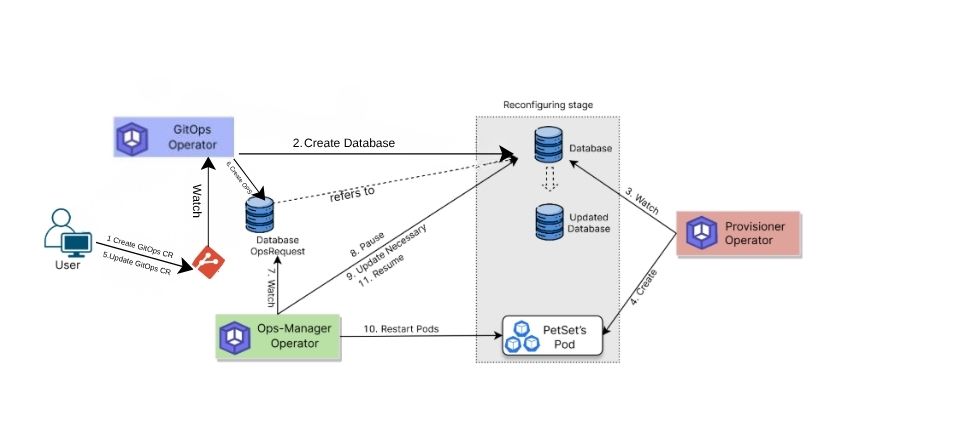
- Define a GitOps
Etcd: write a custom resource of kindEtcdusing thegitops.kubedb.com/v1alpha1API. - Store it in Git: push the manifest to your Git repository.
- Automated deployment: a GitOps tool such as
ArgoCDorFluxCDwatches the repository and applies the manifest to your cluster. - Create the database: the gitops operator validates the spec and creates the corresponding
kubedb.com/v1alpha2Etcdobject, which the KubeDB provisioner then turns into a real cluster. - Handle updates: this is the important part — see below.
Drift becomes an OpsRequest, not a mutation
When you change the committed manifest, the gitops operator does not patch the change straight
onto the live Etcd object. Mutating a running etcd cluster’s spec in place is exactly how you lose
quorum. Instead the operator diffs the wrapper against the live database and, for each meaningful
difference, generates an EtcdOpsRequest — the same safe, ordered, quorum-aware machinery you would
use by hand.
| What you changed in Git | Generated EtcdOpsRequest type | Generated name |
|---|---|---|
spec.podTemplate.spec.containers[etcd].resources, or spec.monitor.prometheus.exporter.resources | VerticalScaling | <name>-verticalscaling-<suffix> |
spec.replicas | HorizontalScaling | <name>-horizontalscaling-<suffix> |
spec.storage.resources.requests.storage | VolumeExpansion | <name>-volumeexpansion-<suffix> |
spec.storage.storageClassName | StorageMigration | <name>-storagemigration-<suffix> |
spec.configuration.tuning | Reconfigure | <name>-reconfigure-<suffix> |
spec.authSecret | RotateAuth | <name>-rotate-auth-<suffix> |
spec.tls | ReconfigureTLS | <name>-reconfiguretls-<suffix> |
spec.version | UpdateVersion | <name>-versionupdate-<suffix> |
spec.monitor or spec.archiver | Restart | <name>-restart-<suffix> |
The suffix is a random string, so a fresh OpsRequest is created for every change and the history stays readable.
A handful of fields are not worth an OpsRequest and are patched onto the live object directly:
spec.autoOps, spec.serviceTemplates, spec.halted, spec.healthChecker, spec.deletionPolicy
and spec.allowedSchemas.
Some things you should know about the etcd-specific behaviour:
spec.replicasscaling goes through the membership state machine. The generatedHorizontalScalingOpsRequest is a thin wrapper: it patches the replica count and waits for the provisioner to converge. Scale-up adds the new ordinal as a raft learner, waits for it to catch up with the leader, then promotes it. Scale-down removes the highest-ordinal member from the etcd membership before the PetSet shrinks. Only one membership mutation happens per reconcile pass.- Shrinking a volume is rejected. If the committed
spec.storagerequest is smaller than the live one, the operator returns an error instead of generating aVolumeExpansion. - Custom configuration means
spec.configuration.tuningonly. etcd’s--config-fileis mutually exclusive with the individual flags KubeDB must set for cluster bootstrap, so there is no free-form config file to reconcile. Removing thetuningblock from Git generates aReconfigureOpsRequest that resets etcd back to the operator defaults. - Autoscaler wins. If an
EtcdAutoscalerin the same namespace targets this database with aspec.computesection, the gitops operator will not generateVerticalScalingOpsRequests for it; same forspec.storageandVolumeExpansion. Otherwise the two controllers would fight over the same fields. - The exporter row is structural.
spec.monitor.prometheus.exporter.resourcesmaps ontoEtcdVerticalScalingSpec.Exporter, which exists for parity with other KubeDB databases. etcd serves its own Prometheus metrics natively and KubeDB deploys no exporter sidecar container, so there is nothing for those resources to apply to.
Status
The wrapper’s status inlines the live database’s status (phase, conditions, and so on) and adds a
status.gitops section recording, per observed generation, which OpsRequests were generated and
where the change request stands — Pending, InProgress, Current or Failed.
Next Steps
- Follow the step-by-step guide in GitOps Etcd using the KubeDB GitOps Operator.
- Detail concepts of the Etcd object.
- Detail concepts of the EtcdOpsRequest object.